claude-code
v0.2.21Claude Code as an iii worker — claude::* runs headless turns and claude::terminal::* runs the same CLI in a shell::pty session on its own console page. Both publish raw messages on the claude::raw-event trigger type and AgentEvent frames on claude::agent-event.
 iiiverified
exact versions are immutable; binary and bundle artifacts are digest-pinned.
configuration
- approval_gate: false
  claude_executable:
  defaults:
    allowed_tools:

    append_system_prompt:
    cwd:
    disallowed_tools:

    max_turns: 50
    model:
    permission_mode: acceptEdits
  engine_url: ws://127.0.0.1:49134
  iii_context: true
  terminal:
    args:

    auto_install: true
    executable:
    setup_workspace: true
    workspace_dir:
readme
open as markdownclaude-code
Claude Code as an iii worker: the Claude Code API exposed as functions and trigger types on the iii bus, nothing else. The worker spawns the same claude binary the user runs in their terminal, with the same login, the same filesystem, and the same tools (file edits, shell, web). claude::run executes one headless turn and returns the result; the raw Claude Code messages are published verbatim on the claude::raw-event trigger type, and a translated AgentEvent view on claude::agent-event, so the iii console, the acp worker, and any sibling worker observe a Claude Code run exactly like a native harness turn. The worker also registers run::start_and_wait, the same entrypoint the console and the acp worker drive, so both run Claude Code with no changes.
The same worker also runs Claude Code as a terminal on the console: claude::terminal::* installs the CLI on the terminal host, equips a workspace with the iii skills, and opens Claude in a shell::pty session on its own page — always Claude, never a shell. Both halves report onto one events stream, so a headless turn and a typed turn look the same in the console. Whether they also share one login depends on where each half runs: from a local checkout both are host processes and read the same ~/.claude, while a worker installed from the registry runs the headless half in a microVM that cannot (see Logging in). Its sibling pi is the same shape for the pi agent.
Install
iii trigger compose::add worker=claude-codeRequires the claude CLI on the host (the Agent SDK shells out to it) and either ANTHROPIC_API_KEY in the worker environment or an existing claude login.
The terminal half adds three companions:
| Worker | Why |
|---|---|
shell ≥ 0.12 |
Owns the terminal. shell::pty::open runs the CLI, shell::exec installs it and equips the workspace, coder::read-file reads the files back. The workspace must be inside shell's jail (fs.host_roots). |
console |
Renders the injected claude page. |
configuration (built in) |
Holds the settings below. |
Skills
Install the claude-code agent skill for Claude Code, Cursor, and 30+ other agents:
npx skills add iii-hq/workers --skill claude-codeQuickstart
From zero to a Claude Code turn over the bus:
curl -fsSL https://install.iii.dev/iii/main/install.sh | sh
iii trigger compose::add worker=claude-code
iii   # starts the engine + worker
Then talk to it like any other function: from the console chat, from iii trigger claude::run, or from any SDK:
import { registerWorker } from 'iii-sdk';

const iii = registerWorker('ws://127.0.0.1:49134', { workerName: 'demo' });

const res = await iii.trigger({
  function_id: 'claude::run',
  payload: {
    prompt: 'Add a /health endpoint to server.ts and run the tests',
    cwd: '/path/to/repo',
    permission_mode: 'acceptEdits',
  },
  timeout_ms: 600_000,
});
// { session_id, claude_session_id, result, stop_reason, usage, total_cost_usd }
Or straight from the terminal with the iii trigger CLI:
# one full turn (raise the timeout; the default 30s is too short for agent turns)
iii trigger claude::run --timeout-ms 600000 \
  --json '{"prompt":"add a /health endpoint and run the tests","cwd":"/path/to/repo"}'

# quick reads use key=value syntax
iii trigger claude::sessions::list
iii trigger claude::status session_id=<session_id>

# background turn + control
iii trigger claude::start --json '{"prompt":"...","cwd":"/path/to/repo"}'
iii trigger claude::stop session_id=<session_id>

# ask the running engine for a function's description
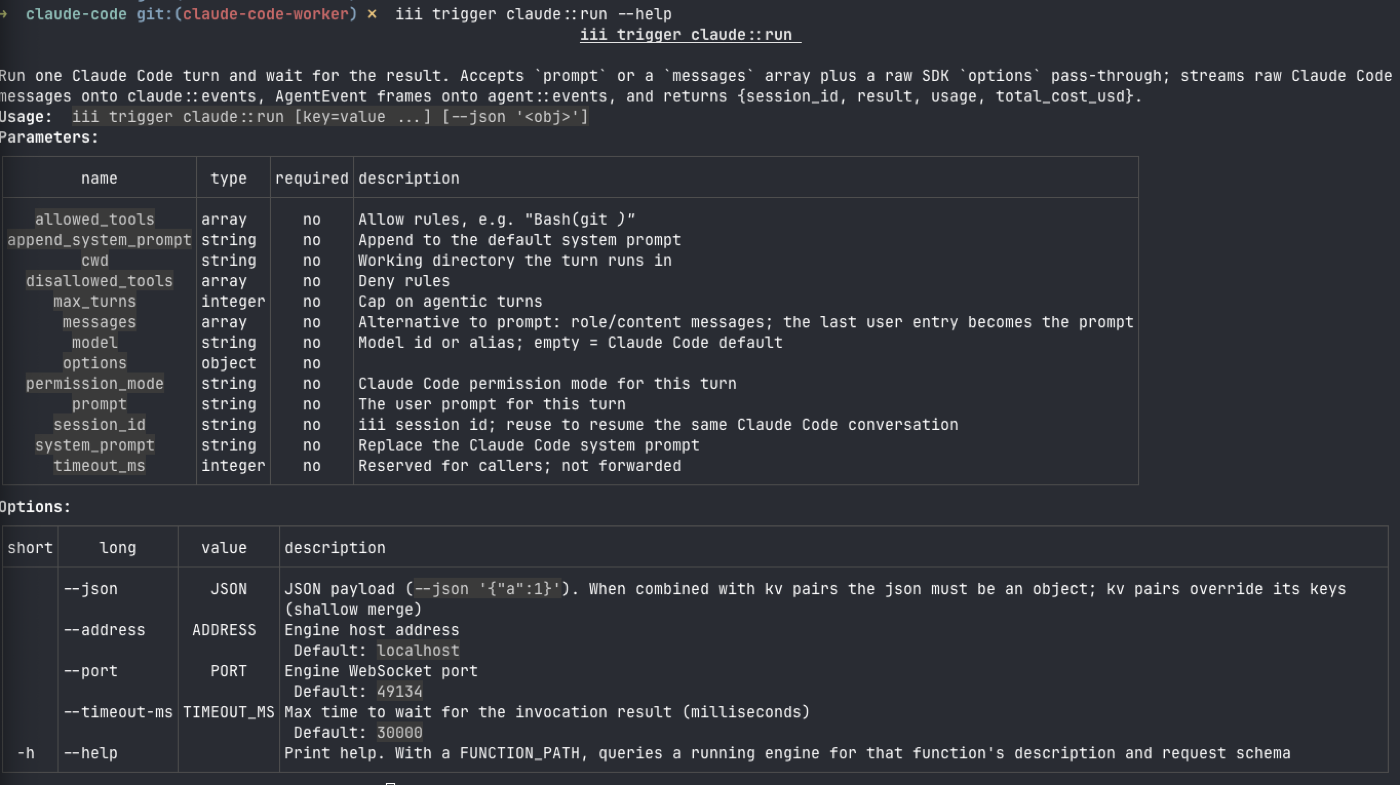
iii trigger claude::run --help
A turn from the CLI and the session record it leaves behind:
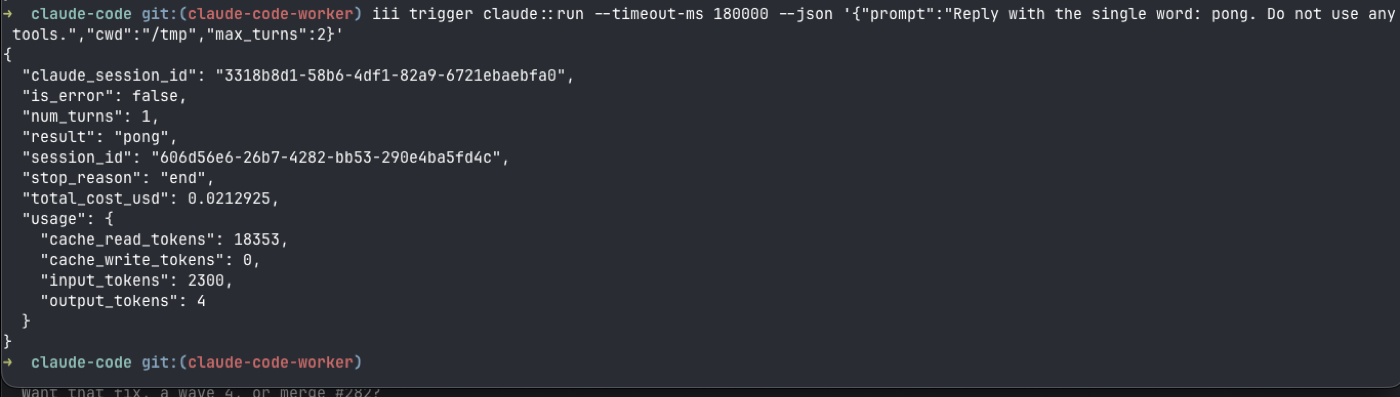
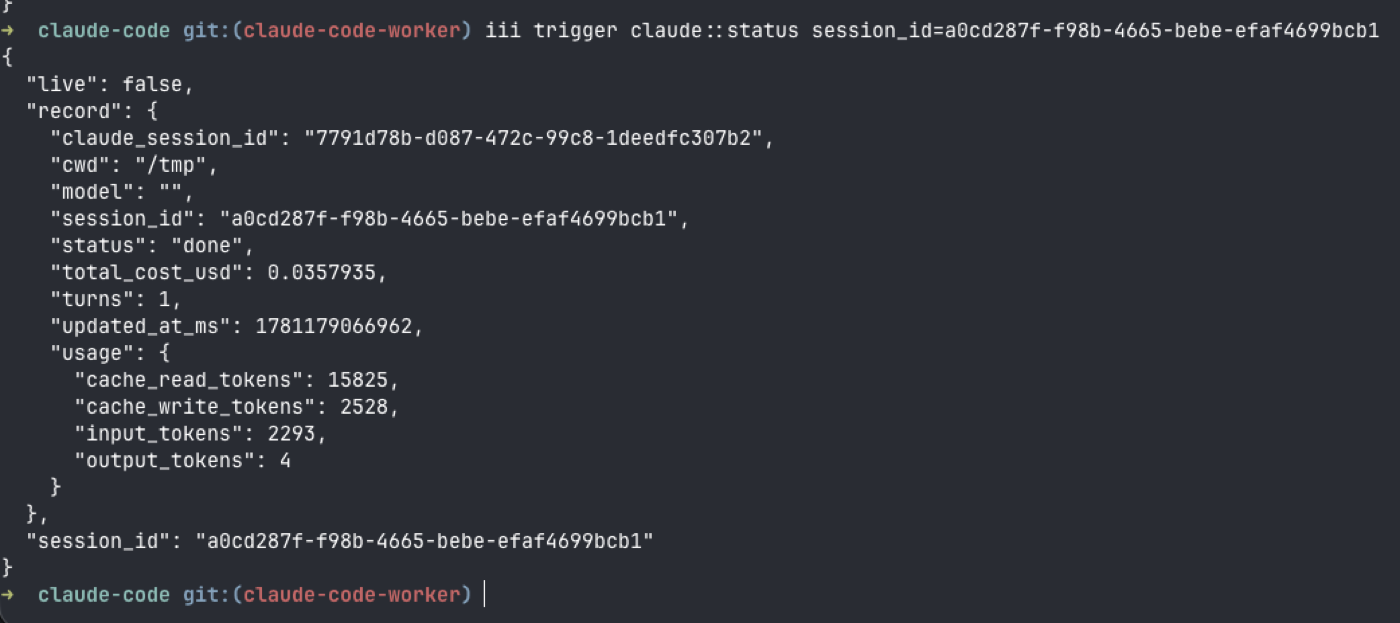
Call claude::run again with the returned session_id to continue the same conversation: the worker maps iii session ids to Claude Code session ids in engine state and resumes automatically.
Two ids come back from every run. session_id is the iii session id: the key for claude::status, claude::stop, resume, and the session_id an event-feed binding filters on. claude_session_id is Claude Code's internal session id (what the worker passes to the CLI's resume under the hood) — returned for reference, not a lookup key.
Long turns: use claude::start to return immediately, then bind claude::agent-event with { session_id } (see Event feeds) for message_complete, function_execution_start/end, and turn_end frames. claude::stop interrupts a live run, claude::status reads a point-in-time view, claude::sessions::list enumerates past sessions.
Functions
| Function | Purpose |
|---|---|
claude::run |
Run one turn, wait, return the final result |
claude::start |
Fire-and-forget turn; progress arrives on claude::agent-event |
claude::task |
Delegate one task as a SUB-AGENT: fire it from a trigger, get the session id back at once, pass parent_session_id to nest it under the session that delegated it, and read the outcome from agent_tasks/ in state — which is what an orchestrator binds a state trigger to and is woken by |
claude::stop |
Interrupt a live run |
claude::status |
Session state, live flag, usage, cost |
claude::sessions::list |
All sessions this worker has run |
run::start_and_wait |
Alias for claude::run under the entrypoint the console and acp worker drive |
claude::terminal::describe |
What a terminal session runs: program, argv, cwd, env — the page passes it straight to shell::pty::open — plus activity_bridge and detail, which say whether the hooks can reach the bus. Internal. |
claude::terminal::activity |
One Claude Code hook event in, AgentEvent frames out. Internal, and trace_hidden — the signal is the stream, not the delivery. |
claude::auth::status |
Which plan a terminal session spends (see Billing). Agent-denied. |
claude::ui-content |
Console page assets. Internal. |
claude::run accepts either a bare prompt string or a messages array ([{ role: 'user', content: [{ type: 'text', text }] }]), plus model, cwd, system_prompt, append_system_prompt, permission_mode, allowed_tools, disallowed_tools, and max_turns overrides.
Raw API pass-through
The named fields above cover the common path; everything else the Agent SDK accepts goes through the options field untouched (camelCase, exactly as in the SDK):
{
  "prompt": "...",
  "options": {
    "forkSession": true,
    "includePartialMessages": true,
    "fallbackModel": "claude-sonnet-4-6",
    "addDirs": ["/another/repo"]
  }
}
And the full output side is available raw: every message Claude Code emits (system/init, assistant, user, result, and stream_event token deltas when includePartialMessages is set) is published verbatim on the claude::raw-event trigger type. Consumers that want the exact Claude Code wire format bind claude::raw-event; consumers that want harness-shaped frames bind claude::agent-event. Same turn, two views.
Event feeds
The worker owns two trigger types and publishes every turn on them (headless
runs, claude::task sub-agents, run::start_and_wait, and the console
terminal):
| Trigger type | event carries |
|---|---|
claude::agent-event |
translated AgentEvent frames (message_complete, function_execution_start/end, turn_end, agent_end) |
claude::raw-event |
every Claude Code message verbatim (system/init, assistant, user, result, stream_event) |
Bind a function to one session with the config { session_id, metadata? }
(session_id required, non-empty, up to 512 characters; metadata is an
optional object handed to your function and wins over the binding's own
metadata; any other key rejects the binding). Each trigger type accepts up to
256 bindings.
iii.registerTrigger({
  type: 'claude::agent-event',
  function_id: 'my::on-claude-event',
  config: { session_id },
});
Your function receives one call per frame, fire-and-forget:
{
  "session_id": "sess_...",
  "event_id": "sess_...-<epoch>-00000007", // dedup key
  "seq": 7,              // contiguous per (trigger type, session_id, epoch), from 0
  "epoch": "<uuid>",     // changes when the worker restarts; seq restarts at 0
  "source": "claude",
  "event": { "type": "message_complete", "message": { } }
}
Deliveries are not guaranteed to arrive in order: order by (epoch, seq) and
drop duplicates by event_id. The two feeds number their frames
independently. The feeds are ephemeral: nothing is stored or replayed, and a
function bound after a frame was published never sees it. The durable history
is the session record (claude::status, claude::sessions::list), the
turn's return value, and the session-manager transcript (session::messages)
the console renders. A consumer that fails or disappears never fails the turn.
These replace the former iii-stream feeds agent::events and
claude::events; the worker no longer needs iii-stream (see the guide
"Migrate from iii-stream and pubsub"). The acp worker binds
claude::agent-event for the brain claude::run; when it drives
run::start_and_wait instead, start it with
--events-trigger-type claude::agent-event.
The agent on the bus
By default every turn's system prompt carries the iii runtime context: the same engine-grounded rules as the harness identity prompts, retargeted to the iii CLI the agent reaches through its shell. The agent discovers capabilities from the live engine instead of memory — iii trigger engine::functions::list to find function ids, iii trigger as the contract before every first call, the registry flow (directory::registry::workers::list/info, worker::add) when nothing registered fits — plus the calling rules and error-handling discipline that go with them. The matching Bash(iii *) allow rule is added automatically so those calls run headless. Local file edits stay on Claude Code's native tools; backend actions go through registered functions.
# the agent answers this by querying the live engine itself
iii trigger claude::run --timeout-ms 300000 \
  --json '{"prompt":"List every worker connected to this engine and what each one does.","cwd":"/tmp"}'
Turn it off per call with "iii_context": false or globally in config.yaml; a caller-supplied system_prompt always wins verbatim and gets nothing appended.
Plan mode and permission modes
permission_mode maps straight onto Claude Code's native modes, per turn:
| Mode | Behavior |
|---|---|
default |
Claude Code's standard permission prompts (headless: unapproved calls fail) |
acceptEdits |
File edits auto-approved; the worker default |
plan |
Native plan mode: read-only exploration, produces a plan, refuses edits |
bypassPermissions |
Skip all permission checks |
Plan mode headless behaves like plan mode in the terminal: the turn ends when Claude finishes the plan, and the plan text is the result — nothing executes. Because the worker resumes sessions, plan-then-execute is two calls against the same session_id:
# 1. plan (read-only)
iii trigger claude::run --timeout-ms 600000 \
  --json '{"prompt":"Plan how to add rate limiting to the REST API. Do not implement.","cwd":"/path/to/repo","permission_mode":"plan"}'

# 2. execute the plan with full context, same conversation
iii trigger claude::run --timeout-ms 600000 \
  --json '{"session_id":"<from-step-1>","prompt":"Implement the plan.","permission_mode":"acceptEdits","cwd":"/path/to/repo"}'
The approval step is whatever sits between the two calls — a human reading the plan, another worker, or a trigger.
The terminal on the console
A claude page appears in the console nav; opening it starts a session. The
first run installs the CLI and the skills, so it takes a minute. Answer the
login prompt in the terminal, then ask Claude to build something on the engine
— the workspace notes and the installed iii skills teach it how to register
functions and triggers. Every prompt and tool call it runs is published on
claude::agent-event, exactly like a claude::run turn.
iii trigger claude::terminal::describe   # what a session runs, and where
iii trigger shell::pty::sessions         # what is actually running
iii trigger claude::status session_id=<session id>   # the session record
iii trigger session::messages session_id=<session id> # the persisted transcript
The page keeps a per-tab lease, so a reload or a pane move reattaches to the same live Claude rather than starting a second one.
A session outlives the tab that opened it: the reattach lease is stored per browser, so closing the console and coming back finds the same agent instead of starting a second one beside it. When the replay would be partial — the worker's ring buffer is finite and an agent repaints constantly — the page skips the broken history and asks the agent to paint its current screen (a one-row resize, which is a SIGWINCH) rather than writing wreckage into the pane.
The status bar carries a font-size stepper (8–40 px, 14 by default; Ctrl or ⌘
- scroll does the same). The size is one value for every terminal in the console — shell's panes included — so it is set once, not per page. The terminal itself stays dark whatever the console theme is: an agent CLI paints its own interface in colors chosen for a dark terminal and never learns the page went light.
What the workspace gets
On every boot, when terminal.setup_workspace is on:
CLAUDE.md, inside anblock the worker rewrites. Anything outside the markers is the operator's and survives. The iii half of that block — how to work against a live engine, and what skills are installed — is FETCHED from theiii-directoryworker (directory::system-prompts::get name=iii-runtimeplusdirectory::skills::index), which is also what a headless turn is given. One copy, one owner: this worker ships neither the prompt nor a second set of skills on disk. When the directory answers nothing, the block says so and points the agent atengine::functions::list..iii-plugin/, a Claude Code plugin the session loads with--plugin-dir. It carries the hooks forSessionStart,SessionEnd,UserPromptSubmit,PreToolUse,PostToolUseandStop— each posting its payload toclaude::terminal::activitywith theiiiCLI, so it works whether or not the terminal host is this worker's host — and theiii-runtimeskill fetched fromiii-directory.The same plugin serves the headless half: the Agent SDK turns
plugins: [{ type: 'local', path }]into that same--plugin-dirflag, so a typed turn and aclaude::runturn get identical hooks and the identical skill from one definition (src/plugin.ts).claude plugin validateaccepts the generated directory..claude/settings.jsonis no longer written at all. It is the operator's file; the plugin directory is this worker's, so it is written whole instead of merged into.
Billing: which plan a session spends
The status bar under the terminal says it, and claude::auth::status answers
it on the bus:
| Badge | Means |
|---|---|
team subscription · you@example.com · org |
A Claude subscription login on the terminal host pays. |
API key billing · ANTHROPIC_API_KEY |
An API key pays, per token. |
not signed in |
No credentials yet — run /login in the terminal. |
The rule has a trap in it, which is why the badge exists: an API key beats a
subscription login. With ANTHROPIC_API_KEY set, claude auth status still
reports authMethod: claude.ai (the account IS signed in) while the CLI bills
the key — it says so itself ("ANTHROPIC_API_KEY or another auth source is set
and takes precedence over your claude.ai login") and a bogus key 401s the turn.
So the badge reads apiKeySource, not authMethod, and the tooltip spells out
that the login is signed in but not billed.
The key is read from the environment of the shell worker that runs the
session, so that is where to set or unset it.
A subscription login needs USER in the session environment. Claude Code
keeps subscription credentials in the OS keychain and finds them by the
current user, and a worker's environment is not the operator's shell — compose
clears it and re-seeds an allowlist from the daemon's own environment, so a
daemon started without USER hands every child a blank one. The CLI then
reports loggedIn: false beside a keychain that plainly holds the login. This
worker asks the terminal host who it is (id -un) and puts USER/LOGNAME
into every session and into the billing probe, so the answer does not depend
on how the daemon was started.
claude::auth::status stays agent-denied in iii-permissions.yaml: it carries
the operator's account and organization. The console page reaches it as a
user-initiated call, which is not the agent path.
Logging in
The simplest flow is the terminal itself: open the page and run /login (or
claude auth login; --console for API billing instead of the subscription).
The credentials land in the home directory of whatever runs the session — the
shell worker's — and every later session of this terminal reuses them.
Who else sees that login depends on how a worker is deployed, not on which
machine it is. Compose starts a container one of two ways
(iii-compose/src/lifecycle.rs):
| Container | Start | Home directory |
|---|---|---|
path://… (local checkout), or a registry worker whose payload is a binary (Rust deploy: binary, e.g. shell) |
host process | the host's |
a registry worker whose payload is a bundle (Node deploy: bundle, e.g. this worker) |
microVM, own rootfs | the guest's |
Only the container's own config directory is shared into a VM (virtiofs), and
compose v1 has no volume field, so a VM-booted worker cannot read the host's
~/.claude. Consequences:
- The terminal half is unaffected either way: the CLI runs inside the
shellworker, which is a host process, so the login is the host's and this worker's own rootfs never matters. - The headless half spawns
claudein this worker's container. Run from a local checkout it is a host process and shares that same login; installed from the registry it is in a microVM and does not. Give it credentials through the channels a VM has:environment/env_fileon its container (ANTHROPIC_API_KEY, or a long-lived subscription token fromclaude setup-token), or theauth-credentialsvault over the bus — which is why that vault exists, and whyprovider-claude-codereads it instead of the file.
If the worker that owns the terminal is virtualized
The terminal half holds because shell is a binary payload and therefore a
host process today. If binary workers get VM-booted too, the terminal keeps
working — the CLI, the workspace, and the login simply move into that guest,
and this worker still reaches them over the bus — but three things change:
- The login belongs to that guest's rootfs. Nothing on the host shares it, and it survives restarts only as long as the guest's state does.
- The workspace is inside the guest, so the agent no longer sees the operator's checkout unless the guest is given it.
- The activity hooks call the
iiiCLI, which may not exist in that guest. The worker probes for it and reports the answer asactivity_bridgeonclaude::terminal::describe(empty = the hooks are installed but mute, anddetailsays so). That is the first thing to check if a terminal works while nothing arrives onclaude::agent-event.
For a terminal host with no one at the keyboard, the same two options apply:
claude setup-token once (needs a browser once, returns a long-lived
subscription token) or ANTHROPIC_API_KEY, in the environment the shell
worker starts with. Either way the badge says which one won.
Configuration
engine_url: ws://127.0.0.1:49134

defaults:
  model: ""                    # empty = Claude Code default
  permission_mode: acceptEdits # default | acceptEdits | plan | bypassPermissions
  max_turns: 50
  cwd: ""                      # default working directory for runs

approval_gate: false           # route tool permissions through policy::check_permissions
claude_executable: ""          # path to the claude CLI; empty = SDK default resolution

terminal:                      # the console terminal page — a DIFFERENT host: shell's
  executable: ""               # path to `claude` there; empty = resolve on PATH there
  args: []                     # extra argv for every terminal session
  workspace_dir: ""            # empty = `claude-code` under shell's primary root
  auto_install: true           # install Claude Code from https://claude.ai/install.sh when missing
  setup_workspace: true        # keep the skills, the engine notes, and the activity hooks in place
Settings live in the configuration worker under the Claude Code entry —
edit them in the Console's global Settings modal; they hot-reload, and a change to the
terminal block re-runs the workspace preparation for the next session.
The event feeds are fixed trigger types, not settings. The former
events_stream / raw_events_stream keys are ignored; a stored
configuration that still carries them keeps loading.
With approval_gate: true and the harness worker installed, every Claude Code tool call is checked against policy::check_permissions before it executes, fail-closed when the gate is unreachable, so the same YAML permission rules and console approval flow that govern native harness turns govern Claude Code.
Observability
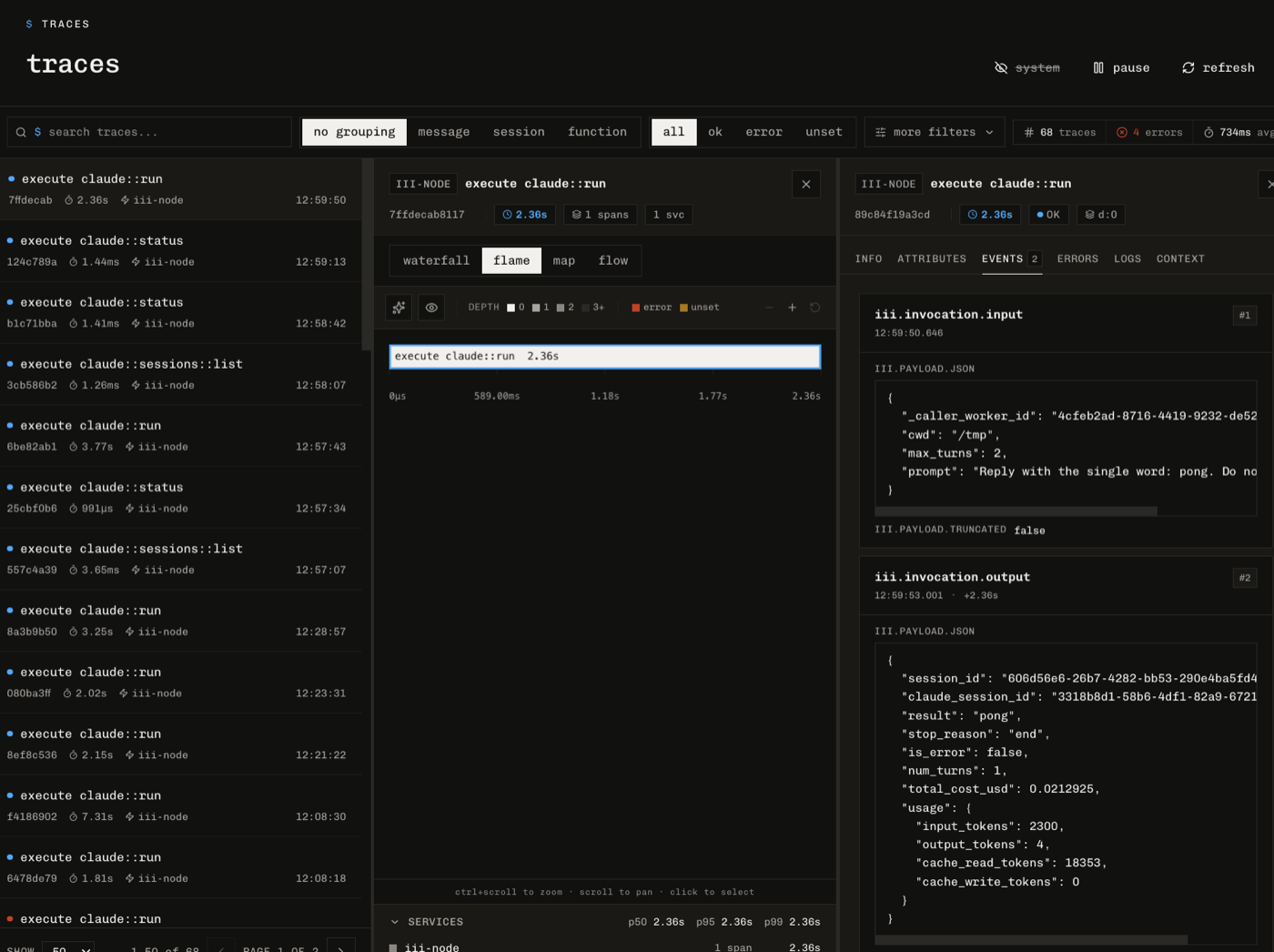
Every claude::run is an ordinary traced invocation on the engine: the trace carries the full input payload (prompt, cwd, caller worker id) and the output (result, stop reason, token usage, cost) as span events, with per-function p50/p95/p99 in the console's trace explorer — no extra instrumentation in the worker.
Turns group like a harness turn
Both halves stamp the identity keys an agent harness stamps, so the trace views
group and label this worker's turns with no knowledge of Claude Code
(ade/docs/timeline-span-tags.md):
| Key | Value here |
|---|---|
iii.session.id |
the iii session — what "group by session" groups on |
iii.message.id |
one turn: one headless claude::run, or one terminal prompt |
iii.tag.kind |
claude.run for a headless turn, claude.terminal.turn for a typed one |
iii.tag.message |
a preview of the prompt |
iii.tag.display_name |
Claude terminal · on the terminal half |
The transport is W3C baggage, so every call a turn makes — and every span those calls produce in other workers — carries the same keys. A terminal turn reaches this worker as several separate calls (one per hook), so its identity lives in those keys rather than in one covering span; a headless turn gets both.
How it maps
| Claude Code | iii |
|---|---|
SDK query() turn |
claude::run invocation |
| every SDK message, verbatim | claude::raw-event delivery |
| assistant message | message_complete frame on claude::agent-event |
| tool_use / tool_result | function_execution_start / function_execution_end frames |
| final result | turn_end + agent_end frames, function return value |
| session resume | engine state scope claude_sessions, keyed by iii session_id |
| permission prompt | canUseTool -> policy::check_permissions (optional) |
| extra capability | another iii worker on the bus (shell, database, storage, ...) |
| interactive CLI session | shell::pty session on the injected claude console page |
| terminal hook event | claude::terminal::activity -> the same claude::agent-event frames |