browser
v0.1.0A browser on the iii bus - shared Chromium with persistent, restorable tabs and incognito tabs. Navigate, act, read the page console, pick elements. Also parses HTML natively without a browser (browser::* - css/xpath/regex, element search, markdown).
 iiiverified
- macOS: arm64 · x64
- Linux: arm64 · armv7 · x64
- Windows: arm64 · x64 · x86



exact versions are immutable; binary and bundle artifacts are digest-pinned.
readme
open as markdownbrowser
Interactive Chromium sessions on the iii engine
bus. Agents start a session, read the page as an accessibility-tree outline,
click and type against element refs, and read the page's own console and
network history back as data. The single most important thing it gives you:
"why is my dev server page blank?" becomes answerable, because the page's
console errors are one browser::console::read away. The console
worker adds the human window: a live Browser page with a streaming viewport
(Chromium-pushed screencast frames), the console feed, and click-to-pick
elements into chat.
In the console
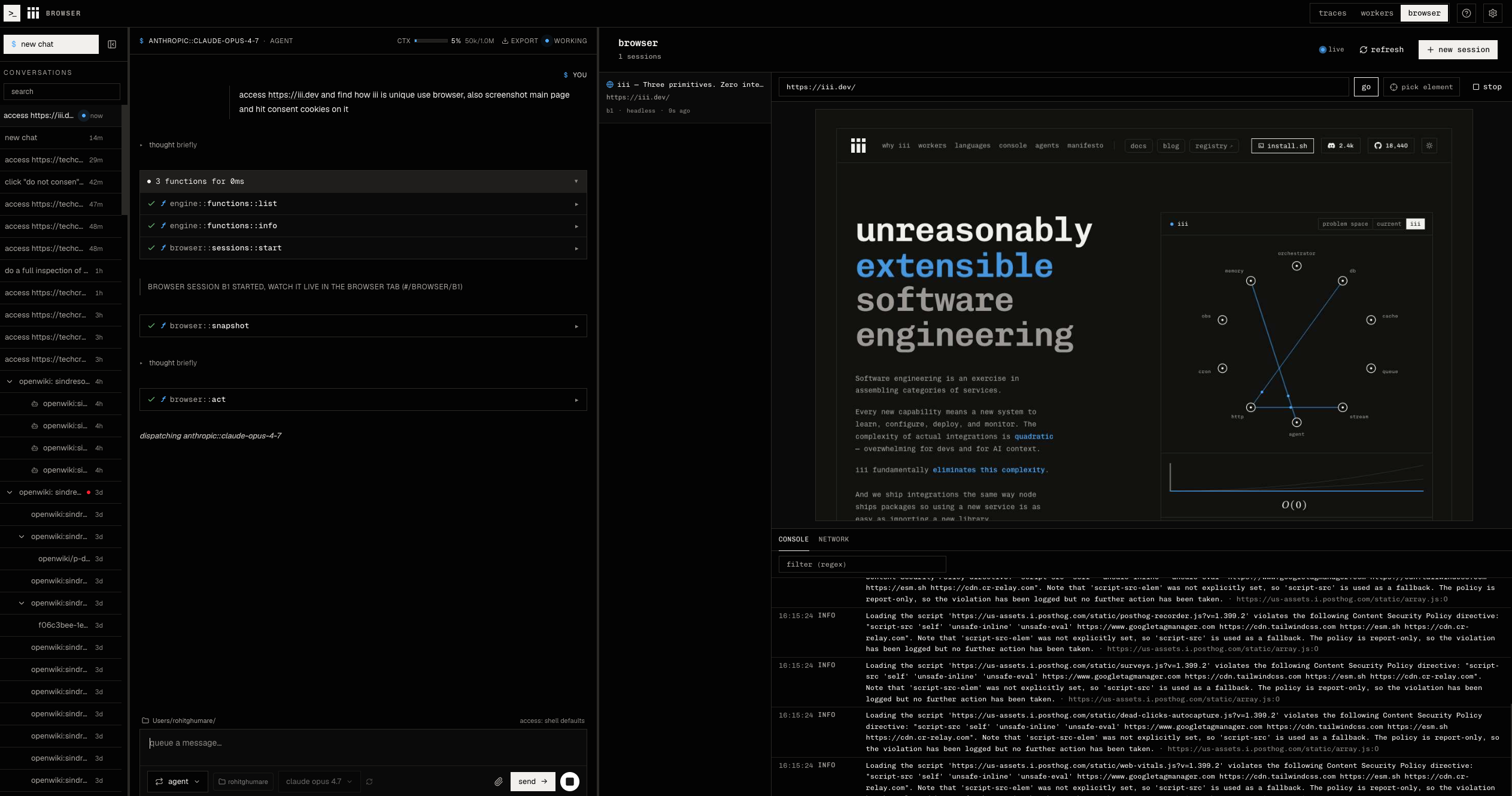
An agent reads a page as an accessibility outline (browser::snapshot) while
you watch the live viewport and console feed:
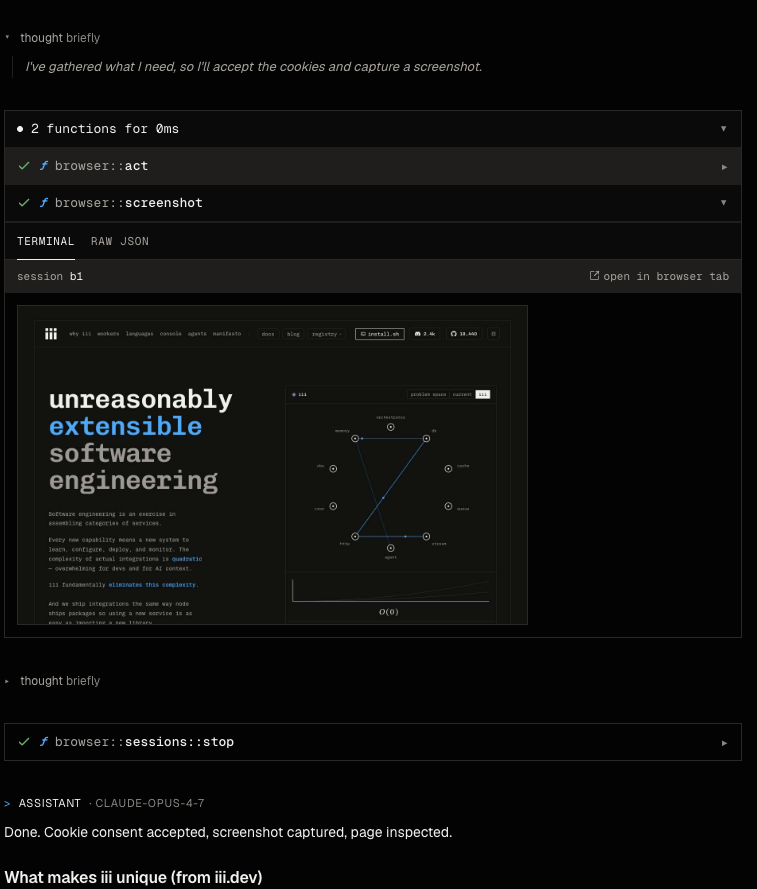
browser::screenshot renders the captured image inline in the chat card:
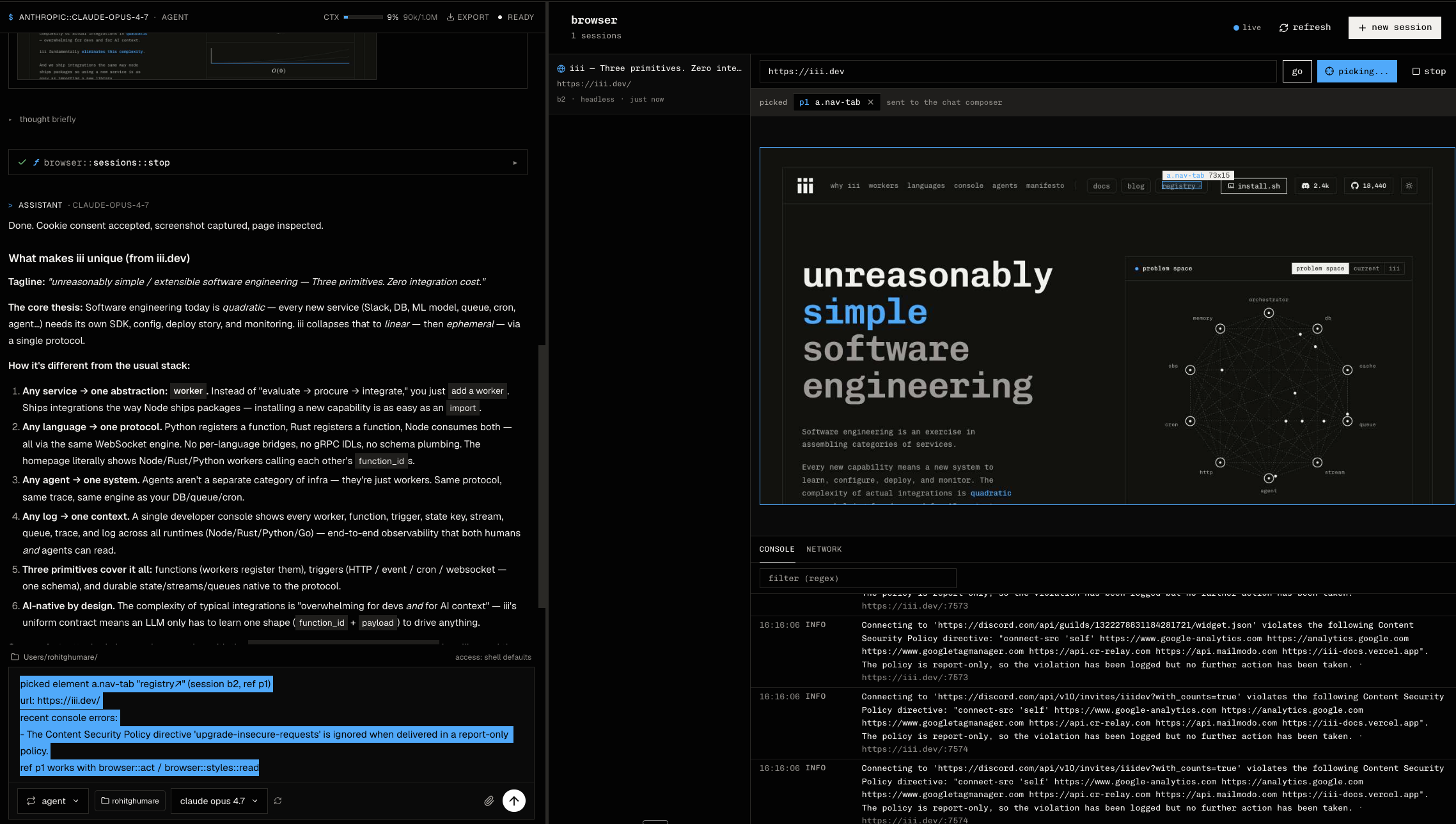
Pick mode highlights the element under the cursor and drops it into the chat composer as an actionable ref:
Install
iii worker add browseriii worker add fetches the binary, writes a config block into
~/.iii/config.yaml, and the engine starts the worker on the next
iii start. The worker drives a Chromium/Chrome already installed on the
machine; point executable at a specific binary if auto-detection picks the
wrong one.
To watch sessions live, pick elements into chat, and follow the agent's browsing from a UI, add the console worker as well:
iii worker add consoleQuickstart
Start a session, read the page, act on it, then read the console:
use iii_sdk::protocol::TriggerRequest;
use iii_sdk::{register_worker, InitOptions};
use serde_json::json;

#[tokio::main]
async fn main() -> anyhow::Result<()> {
    let iii = register_worker("ws://localhost:49134", InitOptions::default());

    let started = iii.trigger(TriggerRequest {
        function_id: "browser::sessions::start".into(),
        payload: json!({ "url": "http://localhost:3000" }),
        action: None,
        timeout_ms: Some(30_000),
    }).await?;
    let session_id = started["session_id"].as_str().unwrap();

    // The page as text: an a11y outline with [ref=eN] handles.
    let snapshot = iii.trigger(TriggerRequest {
        function_id: "browser::snapshot".into(),
        payload: json!({ "session_id": session_id }),
        action: None,
        timeout_ms: Some(15_000),
    }).await?;
    println!("{}", snapshot["tree"].as_str().unwrap());

    // What did the page log? Errors only, no dump.
    let console = iii.trigger(TriggerRequest {
        function_id: "browser::console::read".into(),
        payload: json!({ "session_id": session_id, "level": "error" }),
        action: None,
        timeout_ms: Some(10_000),
    }).await?;
    println!("{console:#}");
    Ok(())
}
The rest of the surface: browser::act (click/hover/type/press/scroll by
ref or coordinates, left/right/middle and double-click), browser::evaluate
(JS expression), browser::screenshot (viewable JPEG), browser::history
(back/forward/reload), browser::network::read (requests + failures),
browser::dom::read (DOM tree with refs), browser::styles::read /
browser::styles::write (computed styles + live inline edits, the design
panel backing), and browser::sessions::list / browser::sessions::stop.
Function ids and schemas live in the code and iii worker info browser.
Configuration
Stored in the configuration worker under the browser key; every field is
editable live from the console. Caps and timeouts hot-reload; executable,
headless, and the viewport apply to sessions started after the change.
browser:
  executable: ''            # empty = auto-detect Chrome/Chromium/Edge
  user_data_dir: ''         # set a path to persist cookies/logins across sessions
  headless: true            # false shows a real window locally
  max_sessions: 4           # concurrent Chromium processes
  console_buffer: 500       # per-session console ring buffer (entries)
  network_buffer: 500       # per-session network ring buffer (entries)
  viewport_width: 1280
  viewport_height: 800
  default_timeout_ms: 30000 # navigation/act/evaluate default
  max_timeout_ms: 120000    # ceiling; caller timeout_ms clamped DOWN to this
  idle_stop_ms: 300000      # stop sessions idle this long; 0 disables
  screenshot_quality: 60    # JPEG quality 1-100
  allowed_schemes: [http, https]
  max_snapshot_nodes: 2000  # a11y outline size cap
Custom trigger types
Sibling workers (and the console UI) can subscribe to session activity. All
bindings accept an optional { "session_id": "..." } filter.
| Trigger type | Fires when | Payload to subscribers |
|---|---|---|
browser::session-started |
A session is up and ready | { session_id, url, headless, timestamp } |
browser::session-stopped |
A session ended | { session_id, reason: "stopped" | "idle" | "crashed", timestamp } |
browser::navigated |
The page committed a navigation | { session_id, url, timestamp } |
browser::console-event |
A console/log/exception entry was captured | { session_id, entry } |
browser::picked |
The human picked an element in inspect mode | { session_id, element, timestamp } |
browser::console-event is high-volume; bind it with a session_id filter
and treat browser::console::read as the durable record. browser::picked
elements carry a ref that browser::act accepts directly, so a human pick
flows straight into agent action.
Element picking
browser::pick::start puts the page in DevTools inspect mode (native hover
highlight); the human's click resolves to tag, attributes, outer HTML, text,
bounds, and recent console errors, emitted as browser::picked. The pick,
hint, screencast, and frame functions are internal: console-UI plumbing, not
agent surface, and they stay out of agent tool lists.